
Have you ever wondered how a single exposed key can stop your business cold?
APIs now carry most internet traffic and power apps, platforms, and backend services across Italy and beyond. Yet only 27% of organizations kept a full inventory in 2024, leaving many teams blind to hidden risks.
The shift to zero trust, centralized OAuth token servers, and gateways for rate limits and logging is not optional anymore. These measures reduce attacks, control access, and protect sensitive data flowing between users, developers, and services.
Real incidents — like the 2024 U.S. Treasury exposure tied to a compromised vendor key — show the price of weak key management. Following standards such as OWASP’s API Security Top 10 helps you prioritize fixes for authorization and authentication gaps.
Key Takeaways
- Securing every api and all apis is foundational for your 2025 strategy.
- Use a defense-in-depth stack: gateway protections, centralized tokens, encrypted transport, and monitoring.
- Map your posture to OWASP Top 10 and zero trust to focus on authorization failures.
- Rotate and vault secrets to cut exposure from leaked keys in public repos.
- Adopt token strategies that fit boundaries: JWTs internally, opaque tokens externally.
- Prioritize fixes that protect users, applications, and business outcomes without slowing developers.
Why API security matters in 2025: rising risks, evolving architectures, and your attack surface
In 2025, your digital perimeter is defined more by services and endpoints than by firewalls. Modern organizations run hundreds of apis across teams and cloud regions. That scale creates blind spots that harm your users and business.
Only 27% of firms had a full inventory in 2024, so many endpoints live undetected. A single compromised credential can cascade — the U.S. Treasury case on Dec. 30, 2024 shows how one leaked key affected downstream applications and services.
You face rising risks as microservices and GenAI agents multiply traffic and create new integration patterns. Misconfigurations and zombie endpoints often persist and leak sensitive data or information attackers want.
To reduce attack likelihood, combine continuous inventory with encryption and centralized management. Gain visibility into every endpoint and traffic flow so your organization can spot attacks, prioritize fixes, and protect critical infrastructure and users.
- Treat credential sprawl as enterprise risk and rotate or vault secrets.
- Differentiate abuse from design gaps, then prioritize fixes that cut business impact.
- Pair prevention with detection so you can respond quickly when incidents occur.
Build a real-time API inventory: continuous discovery to eliminate shadow and zombie APIs

Discovering every live endpoint in real time prevents hidden services from becoming business liabilities. A continuous inventory stops unknown resources from drifting into exploitable gaps.
Automated discovery across clouds, gateways, and specs
Implement automated discovery that ingests from gateways, code repositories, and open specs. This enumerates apis across accounts and regions, including unmanaged endpoints.
Do not rely on manual lists. Continuous feeds spot new deployments and undocumented changes before they affect users or applications.
Cataloging by version, criticality, and data sensitivity
Catalog each entry with version and lifecycle state—beta, GA, or deprecated—to avoid zombie apis serving stale logic. Tag criticality and external exposure so teams can prioritize fixes based on business impact.
Continuously classify data types and sensitive data so your organization can map where secrets and user data flow. Link each record to owners, runbooks, and the resources it touches to speed audits and remediation.
- Detect drift by comparing live discovery to declared specs and policies.
- Integrate the inventory with management workflows for reviews and approvals.
- Add infrastructure context—public exposure and network paths—to rank the most exploitable endpoints first.
Operationalize governance by auto-triaging newly detected shadow endpoints to owners. This reduces risks and proves continuous coverage aligned to OWASP guidance for inventory management.
API gateways and centralized controls: your first line of defense
Place a gateway at your edge to turn chaotic request flows into manageable, enforceable streams.
Gateways centralize rate limiting, throttling, header and path rewriting, logging, and metrics for every request. Put each api behind a gateway to enforce uniform controls and simplify changes across services.
Rate limiting, throttling, and traffic shaping at the edge
Shape traffic with quotas and throttles to protect compute and preserve user experience. Segment limits by plan, client, or endpoint so good users keep working when attackers hit you.
Policy enforcement, logging, and threat visibility
Enforce deny-by-default rules, allowlists, and schema validation to block malformed requests. Centralize logs and traces at the edge to correlate spikes, errors, and anomalous requests across the network.
When to complement gateways with WAF, bot detection, and DDoS protection
Layer specialized tools for attack patterns and volumetric threats. WAFs stop known exploits, bot detection reduces scraping, and managed DDoS mitigates high-volume campaigns.
| Control | Edge Role | Benefit | When to Use |
|---|---|---|---|
| Rate limits | Throttle requests per client | Protects compute and availability | High traffic spikes or abusive clients |
| Policy enforcement | Schema + auth checks | Blocks malformed and unauthorized requests | All public-facing endpoints |
| Threat layers | WAF, bot detection, DDoS | Mitigates automated attacks and volumetric load | When abuse or attacks increase |
- Offload normalization, header sanitation, and caching to the gateway.
- Use mTLS terminators and segmentation to limit blast radius.
- Require structured logs and trace headers for faster investigations.
Centralize authentication and authorization with OAuth 2.0 and OIDC
Delegating token issuance to a dedicated authorization server reduces errors and speeds incident response. Centralization simplifies signing, key rotation, and consent flows so teams across Italy can rely on a single source of truth.
Use OpenID Connect to add an identity layer for user flows. This prevents apps from handling primary credentials and improves user trust. Document grant types, redirect URIs, and PKCE so developers implement flows correctly.
- Issue tokens from a central server to manage client authentication, signing, and JWKS rotation.
- Apply scoped access and the principle of least privilege so each application or service gets only needed rights.
- Avoid mixing authentication methods at the same endpoint to prevent downgrade attacks.
- Standardize JWT validation with company libraries to enforce signature, issuer, audience, and exp/nbf checks.
| Control | Where enforced | Role | Benefit |
|---|---|---|---|
| Scopes | Gateway | Coarse access control | Fast rejection of overbroad requests |
| Claims | Backend services | Fine-grained decisions | Business-level authorization |
| Token introspection | Auth server | Session revocation | Quick containment after incidents |
| JWKS rotation | Auth server + validators | Key distribution | Automated trust update without redeploys |
Tokens done right: JWTs internally, opaque tokens externally
Make token shape a security decision: opaque tokens at the edge, signed claims inside your network.
Issue opaque tokens to external clients so partners never see internal claims. At the gateway, apply a phantom or split-token pattern to translate that opaque value into a JWT for internal hops.
Phantom and split token patterns via the gateway
Use a phantom token pattern when the gateway maps an opaque token to a short-lived internal JWT without exposing claims to the caller.
The split-token approach keeps an external token and a separate internal token so you avoid leaking claim shapes to integrators.
Token exchange across trust boundaries
When a downstream service needs its own caller-specific credential, perform a token exchange. Mint purpose-limited, audience-specific tokens to reduce replay risks and confine access.
JWKS for key distribution and rotation
Publish JWKS from your authorization server so services can fetch and cache signing keys. This enables seamless rotation without breaking valid requests.
“Translate opaque tokens at the gateway and use token exchange to keep claims tight and auditable.”
| Pattern | Where enforced | Benefit |
|---|---|---|
| Opaque tokens | Edge / Gateway | Prevents claim exposure to external clients |
| Internal JWTs | Service mesh / internal hops | Fast authorization with rich claims |
| Token exchange | Auth server + gateway | Audience-specific, short-lived tokens |
- Validate signature, exp, aud, and issuer at every hop.
- Avoid forwarding external tokens upstream; mint new ones per service.
- Log exchanges and claim transforms for traceability and audits.
API security best practices at the authorization layer

Treat access decisions as a two-step process: coarse gates at the edge, and precise checks inside your services. This layered model reduces load and limits fallout from a gateway bypass.
Coarse-grained access with scopes at the gateway
Use scopes to block broad categories of calls early. The gateway should reject requests that lack required scopes so downstream applications see fewer requests to parse and validate.
Fine-grained, claims-based authorization in your APIs
Enforce object-level checks inside each api. Tie claims to resource ownership and user identity to stop BOLA-style breaches.
Scope tokens narrowly so callers get only the rights they need. Codify claim logic as code and add tests to avoid regressions.
Zero trust defaults: verify, encrypt, and deny by default
Verify every token on every call, even if the gateway transformed it. Encrypt east–west traffic and apply deny-by-default policies.
“Verify every token, log allow/deny outcomes, and keep claims narrow and auditable.”
- Use contextual attributes (tenant, risk score) for adaptive decisions.
- Treat admin flows with step-up authentication and tighter rate limits.
- Log outcomes with claim snapshots for audits without storing sensitive values.
| Layer | Primary check | Benefit |
|---|---|---|
| Gateway | Scopes, rate limits | Fast rejection of broad abuse |
| API | Claims, object-level checks | Prevents unauthorized resource access |
| Auth server | Token scoping & introspection | Limits lateral movement and speeds revocation |
Encrypt traffic in every direction: TLS, HTTPS, and mTLS
Treat encryption as universal hygiene: every connection must defend the data in transit. Use HTTPS with valid certificates everywhere so requests, tokens, and sensitive payloads cannot be intercepted or tampered with.
Enforce TLS 1.2+ on every path, including internal east–west traffic in your mesh or service fabric. This prevents attackers on the network from reading data or replaying tokens.
TLS 1.2+ everywhere, including internal east–west traffic
Deploy automated certificate management and renewal so applications stay encrypted without outages from expired certs.
Disable weak ciphers, enable HSTS, and tune modern TLS settings to avoid downgrade attacks.
mTLS for sensitive B2B and service-to-service communication
Use mTLS where mutual identity matters—partner links, payment services, and admin APIs. Issue distinct certificates per environment and tenant to segment trust.
- Prefer private links or VPNs to reduce public exposure.
- Encrypt sensitive headers and ensure proxies preserve them.
- Continuously monitor for self-signed certs, old protocols, and revocation failures.
“Encryption stops network-level attacks and protects tokens and data in transit.”
| Measure | Where | Benefit |
|---|---|---|
| TLS 1.2+ | All traffic | Prevents interception |
| mTLS | B2B, service hops | Mutual authentication |
| Cert automation | CI/CD & infra | Reduces outages |
Validate inputs and minimize data exposure

Validate every incoming payload so malformed or hostile inputs never reach your business logic.
Schema-first validation stops injections and SSRF by constraining inputs to known shapes and types. Define request and response schemas, and enforce them at the gateway or in middleware. Libraries like express-validator can help enforce constraints in code and shift checks left into tests.
Limit what you return. Only expose fields required by the client to reduce the blast radius of any inadvertent disclosure. Implement output encoding and consistent error handling so internal stack traces and secrets never leak to callers or logs.
Practical measures to reduce risks
- Enforce size limits, allowlists, and type checks to reject oversized or malformed requests early.
- Sanitize outbound URL fetchers and restrict hostnames, protocols, and IP ranges to prevent SSRF.
- Encrypt sensitive data at rest with managed KMS and avoid logging tokens or personal identifiers in plaintext.
- Review object-level access controls so callers cannot read or mutate fields outside their authorization.
| Constraint | Where enforced | Benefit |
|---|---|---|
| Schema validation | Gateway / Middleware | Prevents injection and malformed inputs |
| Output minimization | Service layer | Reduces exposed data and information leakage |
| SSRF host allowlist | Outbound filters | Stops server-side request abuse |
| Redaction & masking | Support tools & logs | Protects customer privacy |
“Adopt strict schemas, return less, and test these guards so changes do not widen exposure over time.”
Performance safeguards: rate limiting, quotas, and abuse detection
Traffic surges and stealth probes both strain backend capacity and expose flaws in rate control.
Start by treating availability as a security and cost issue. Set multi-dimensional limits so a single burst does not take down services or inflate cloud spend.
Defend against DDoS and resource exhaustion
Front public endpoints with CDNs and managed DDoS services to absorb volumetric attacks at the edge.
Use sensible quotas and budgets for tenants and endpoints to avoid runaway usage on expensive operations.
Design graceful degradation and backpressure so core flows stay responsive while nonessential work is delayed.
Detect anomalous patterns: enumeration, header abuse, and evasion tactics
Monitor for predictable ID sequences, unusual header values, and many keys from new accounts. These are common abuse indicators.
Correlate spikes across regions and origins to separate organic growth from coordinated attacks, and alert on sudden error-rate shifts or auth failures.
- Apply per-IP, per-token, per-tenant, and per-endpoint limits to slow stealth attacks without blocking users.
- Throttle expensive queries, require pagination and cursors, and cap heavy operations.
- Limit client creation and tie quotas to verified identities to prevent key farming (for example, block disposable email signups).
“Multi-dimensional limits and fast detection keep resources available and costs predictable.”
| Measure | Where enforced | Benefit | Example |
|---|---|---|---|
| Rate limits | Gateway / Edge | Stops request floods | 100 req/min per token |
| Quotas & budgets | Tenant billing | Prevents runaway spend | Monthly compute cap |
| DDoS / CDN | Edge network | Absorbs volumetric traffic | CDN caching + scrubbing |
| Anomaly detection | Central logs | Early abuse flags | Enum pattern detection |
Test, monitor, and audit continuously across the API lifecycle
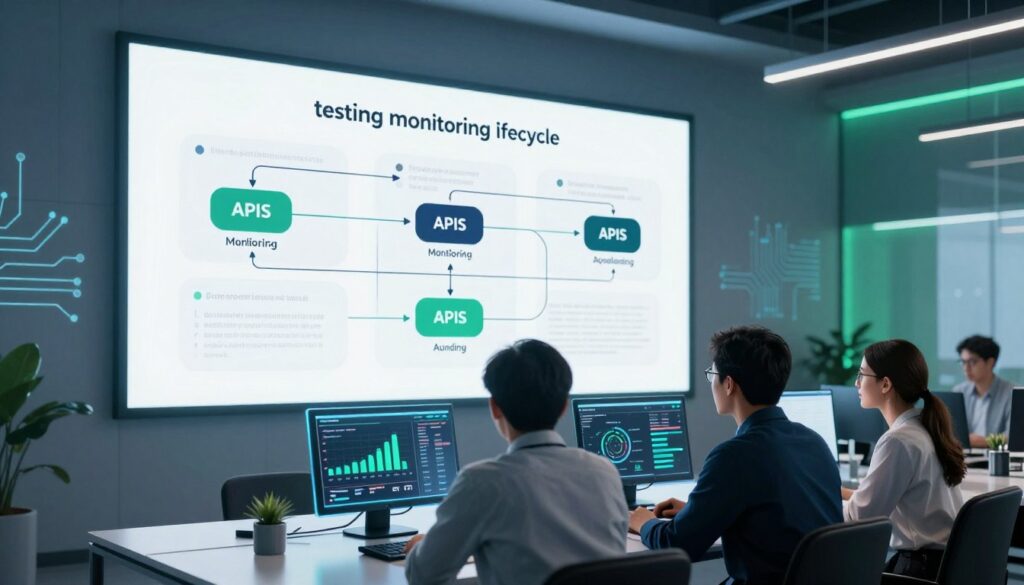
Combine developer checks with runtime scans so small changes do not become large incidents. Shift-left testing, live scanners, and governance reviews form a single, repeatable process across your organization.
Shift-left and runtime testing
Run contract tests in CI to keep developers fast and confident. Add DAST and tools like Nuclei in staging and production to find misconfigurations and known flaws that slip past unit tests.
Centralized logging, metrics, and reviews
Centralize logs, traces, and metrics for all endpoints so you can correlate events across services. Keep logs immutable and privacy-aware to support investigations without leaking customer data.
- Standardize a triage workflow with owners, SLAs, and clear remediation steps.
- Map findings to code locations so developers fix issues faster and with fewer cycles.
- Audit policies and architecture regularly to confirm coverage and reduce long-term risks.
“Prioritize fixes by data exposure, public reachability, and privilege to cut real business impact.”
Exercise runbooks through tabletop drills and red-team scenarios so teams can respond under time pressure. Track MTTR, coverage, and open vulnerabilities to show progress and align improvements to business outcomes.
Secrets and key management in practice: API keys, tokens, and session handling
Treat secret handling as an operational habit, not a one-time task. With 61% of organizations exposing secrets in public repositories, you must assume leaks will happen and prepare to act fast.
Rotate, scope, and store secrets with managed vaults
Keep keys and credentials out of code and config files. Use a managed vault with strict audit trails and role-based controls. Rotate secrets on a schedule and after any suspected leak.
Scope values narrowly by service and environment so a compromised secret cannot grant broad access. Automate rotation through CI/CD and publish signing keys via JWKS when the authorization server supports it.
Browser safety: BFF/token handler and secure cookies over local storage
Do not expose long-lived JWTs to the browser. Adopt a backend-for-frontend or token handler to hold tokens on the server and issue HTTPOnly, Secure, SameSite cookies to the user.
Limit cookie lifetime, restrict scope, and ensure logout or revocation invalidates sessions. Monitor repos and registries for leaked credentials and revoke them immediately.
“Keep tokens off the page, scope secrets tightly, and automate rotation so you can contain leaks quickly.”
- Enforce mTLS or IP allowlists for critical automation.
- Use short-lived tokens and client attestation to minimize blast radius.
- Document rotation playbooks and alert on anomalous credential use as an example of good detection.
Conclusion
, A layered program that ties inventory, token management, and edge controls will keep exposures small as systems grow.
You should centralize authentication and authorization, use opaque tokens at the edge and JWTs internally, and enforce access close to resources. This reduces data leakage and limits attacker movement.
Minimize returned fields, validate inputs, and encrypt sensitive data in transit and at rest. Combine rate limits, quotas, and anomaly detection so attacks hit defenses before they reach critical systems.
Operationalize governance with audits, standard code libraries, and clear runbooks. Rotate and vault keys, prefer server-side session handling for browsers, and measure progress with simple metrics tied to business outcomes.
In short: apply layered controls, keep discovery and rotation continuous, and make authorization least-privilege by default to protect users and your business over the API lifecycle.
FAQ
What should you prioritize first when protecting REST and GraphQL endpoints in 2025?
Start by creating an accurate, real-time inventory of your endpoints. Discover shadow and zombie services across clouds, gateways, and CI/CD pipelines. Then enforce centralized controls at the edge with rate limiting, authentication, and logging so you reduce your attack surface while gaining visibility into traffic and behavior.
How do you centralize authentication and authorization effectively?
Use a dedicated authorization server implementing OAuth 2.0 and OpenID Connect. Issue signed tokens from a single source of truth, apply scope-based access aligned with the principle of least privilege, and standardize token validation via shared libraries to avoid inconsistent checks across services.
When should you use JWTs versus opaque tokens?
Use JSON Web Tokens internally when low-latency, stateless verification helps performance, but prefer opaque tokens for external clients and untrusted boundaries. Combine patterns like phantom or split tokens at the gateway and use token exchange for service-to-service calls across trust domains.
How do you manage keys and token rotation without downtime?
Publish keys through JWKS endpoints and design clients to accept multiple keys during rotation windows. Automate rotation using your identity provider or key management service, and validate signatures against the JWKS set so you can swap keys seamlessly.
What role should an API gateway play in your defenses?
Treat the gateway as your first line of defense: enforce rate limits, quotas, and coarse-grained authorization. Handle threat mitigation, logging, and telemetry there. Complement the gateway with web application firewalls, bot detection, and DDoS protection when you face high-volume or targeted attacks.
How can you protect against injection, SSRF, and data overexposure?
Adopt schema-first validation for inputs and outputs to block malformed requests early. Implement strict allowlists, sanitize inputs, and return only required fields. Classify and redact sensitive data at rest and in transit to minimize exposure.
What encryption measures are required for internal and external traffic?
Enforce TLS 1.2 or higher everywhere, including east-west traffic. Use mutual TLS for high-trust B2B or service-to-service channels. Ensure certificate lifecycle management and automated renewal to avoid expired credentials disrupting service.
How do you apply fine-grained authorization within services?
Use claims-based policies and attribute-aware checks inside your APIs. Implement role and attribute evaluation tied to user identity and resource context, and keep coarse-grained checks at the gateway to filter broad access while delegating detailed decisions to the service.
How should you handle secrets, API keys, and session tokens?
Store secrets in managed vaults, rotate them frequently, and scope keys to the smallest necessary privileges. Avoid local storage of long-lived tokens in browsers; use a backend-for-frontend approach or secure cookies. Log access to secrets and enforce short token lifetimes where practical.
What testing and monitoring work best across the lifecycle?
Shift security left with SAST, contract tests, and DAST integrated into CI/CD. Combine runtime scanning, centralized logging, metrics, and alerts to detect anomalies like enumeration or header abuse. Regularly audit policies and perform threat modeling and red-team exercises.
How can you defend against DDoS and resource exhaustion?
Apply rate limiting, quotas, and traffic shaping at the edge. Use autoscaling cautiously and couple it with quotas to avoid amplified costs. Employ bot management, CDN caching, and DDoS mitigation services to absorb and filter malicious traffic.
What governance and operational controls help reduce risk?
Enforce discovery, cataloging by version and sensitivity, and lifecycle policies for retirement. Require code and policy reviews, centralized logging, and incident response playbooks. Train developers on secure token handling and standardized libraries to avoid ad hoc implementations.