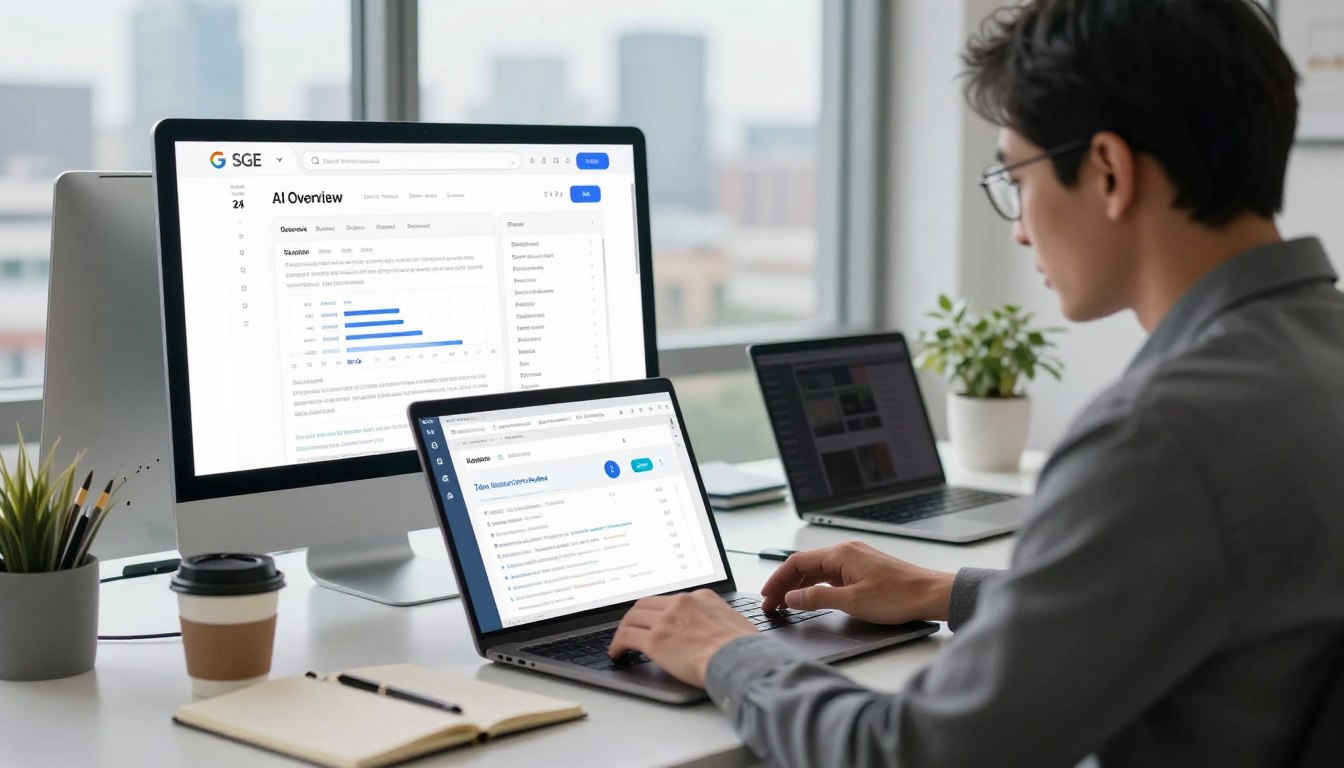
Imagine your best article being summarized elsewhere before a user ever visits your site. By November 2025, roughly 60% of SERPs include AI overviews, up from about 25% in August 2024.
This means decisions now happen inside those summaries and panels. These overviews typically cite about eight trusted sources, so inclusion and citation often determine whether your brand gets seen and credited without a click.
You must reframe your approach to content and technical work to win presence in Google overviews and other engines’ panels. Treat modern models and agents as primary discovery tools: they summarize information, give concise answers, and shape user choice across platforms like ChatGPT, Gemini, and Perplexity.
Focus on clear structure, entity-rich passages, up-to-date data, and reliable citations to improve visibility, protect traffic, and support your brand’s credibility in these new assisted experiences.
Key Takeaways
- Zero-click behavior means you must earn citations inside overviews to keep visibility.
- AI overviews cite about eight sources — optimize content to be one of them.
- Use clear formatting, concise extraction points, and reliable data to help models cite you.
- Expect different platforms and tools to mix article and video sources; adapt content accordingly.
- Track citations inside panels to measure brand impact beyond traditional traffic.
Why AI-Driven Search Changed the Game for Your Organic Strategy
Quick answers now lead discovery. When an engine gives a concise, sourced response, many users stop there. That means being cited in the summary layer can matter more than ranking first in a classic link list.
Zero-click behavior exploded in 2024. Roughly 60% of Google searches produced no click, showing users often accept the overview as sufficient. In late 2025, about 60% of SERPs included AI Overviews, up from roughly 25% in mid‑2024 after the feature rolled out in May.
From zero-click to AI Overviews: what the shift means for visibility
The field of visible real estate has compressed. Your content must be extractable and clearly sourced so platforms can cite it in a short panel. Perplexity cites sources nearly every time, Gemini shows sources about 30% of the time, and GPT lists sources only when asked.
Key 2024-2025 stats you can’t ignore
- Zero-click rate ~60% in 2024, cutting downstream traffic unless you’re cited.
- AI Overviews appeared in ~60% of SERPs by Nov 2025.
- Average cited sources per overview: ~8 (range 4–16) — inclusion is competitive.
SEO for AI search results
When agents assemble answers, your content must be easy to extract and trust.
What this approach is: It shifts focus from classic ranking tactics to clear structure and trustworthy facts. You build pages that language models can parse, cite, and reuse in synthesized answers.
Practical moves include entity-rich passages, short headings, TL;DR summaries, and JSON-LD that labels the page type. These signals help models find and interpret your information.
“Optimize to be quoted, not just to rank.”
- You’ll optimize content for inclusion in generated answers, not only for link lists.
- Unlike traditional seo that relied heavily on keywords and backlinks, this method favors facts, FAQs, and clear examples.
- Use natural-language questions, concise definitions, and internal links to show topical depth across pages.
- Measure success via citation share, brand mentions in panels, and assisted conversions rather than only page ranks.
Tip: Keep language plain, update often, and combine technical hygiene (crawlability, Core Web Vitals) with structured excerpts so engines can quote you with confidence.
Understanding Google SGE, AI Overviews, and AI Mode
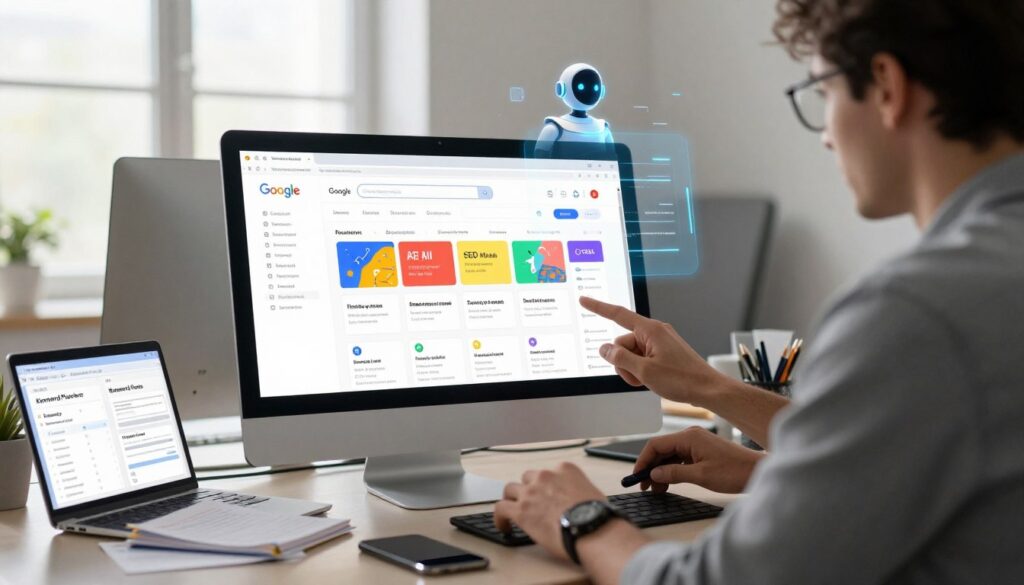
Overview panels now harvest a handful of trusted pages and condense them into a single answer. That shift changes how your pages earn visibility in modern search.
How overviews pick sources: Since the May 2024 launch, google overviews appeared on about 60% of SERPs by November 2025. Panels typically include ~8 links, so being one of those cited pages boosts your brand even when a user doesn’t click.
Selection signals that matter
- Recency and facts: fresh data wins on fast topics.
- Clear structure: short headings and explicit answers make extraction easier.
- Schema: JSON-LD (Article, FAQPage, HowTo) helps classify your page.
- Authority: YMYL pages need higher trust—cite experts or institutions.
When summaries replace clicks—and how to still earn traffic
Zero-click behavior jumped to roughly 60% in 2024. Even so, you can entice visits by offering unique assets users must open to use.
Examples: original data sets, calculators, interactive visuals, downloads, or clear CTAs that promise more than the panel can show. Also monitor where your brand appears inside the card and refine headings and meta to improve click likelihood.
“Make your page the concise, authoritative source a panel can quote—and the richer destination a user will click through to.”
| Platform | Citation Behavior | Best Page Type |
|---|---|---|
| Perplexity | Consistently cites sources | Data-rich articles, pages with clear references |
| Gemini | Shows sources ~30% of the time | Authoritative summaries with schema |
| GPT (Chat) | Rarely lists sources unless prompted | Definitive guides and original assets |
User Intent in the Age of AI: Conversational Queries and Follow-ups
Conversational queries push pages to act like assistants: give a crisp reply first, then offer context and follow‑ups.
Design to answer the first question—and the next. Start each section with a one‑line answer a model can extract. Then add short supporting paragraphs that expand facts, timing, or regional nuances for Italy.
Use headings that mirror how people ask questions. Subheads written as direct questions help engines and users scan and follow the thread.
Adopt the inverted pyramid: lead with the key answer, then add details and sources. This order improves extractability and boosts the chance a passage is cited.
- Front-load an explicit answer sentence at each section start.
- Include concise Q&A blocks and an FAQ that anticipates follow‑ups.
- Offer checklists or numbered steps so models can surface scannable snippets.
Test different question phrasings and track which queries your pages are used to answer. Iterate headings and microcopy to tighten extraction points and increase inclusion in assistant responses.
Entity-Rich, Structured, and Scannable: Content That LLMs Prefer
Clear entity signals let models pick the correct topic and avoid ambiguity.
Use named brands, product models, regulations, and dates to disambiguate topics. Short, labeled claims help an LLM match your content to knowledge graph nodes and improve visibility in panels.
Formats that lift: lists, how-tos, Q&A blocks, TL;DRs, and tight bullet summaries are easiest to extract. Add an explicit one-line answer at section starts so a model can grab a clean quote.
Match depth to intent. General guides perform best near 1,500 words while YMYL pages do better around 1,000 words with strong citations and visible update dates. Include at least two images with descriptive alt text to aid comprehension.
“Lead with a precise claim, follow with short steps, and link entities to hub pages.”
| Format | General Share | YMYL Share |
|---|---|---|
| Lists | 35% | 91% |
| How-tos | 30% | 4% |
| Guides | 15% | 3% |
| Dates in titles | 8% | 20% |
Structured Data and Schema Markup That Improve AI Comprehension

Clear schema helps machines understand whether a page is a guide, product, or FAQ.
Use JSON-LD as your primary format. Declare types like Article, FAQPage, HowTo, Product, and Organization so models can classify your page purpose quickly.
Add QAPage and BreadcrumbList where questions and site structure matter. Include VideoObject with transcripts on pages that embed YouTube to boost mixed-media comprehension.
Ensure fields are complete: headline, datePublished, dateModified, author, publisher, and mainEntity. These items reduce ambiguity and signal fresh data.
Map page intent to schema
Don’t tag every document as Article. Match schema to the real intent of the page so engines trust your classification and may surface a passage in panels.
“Keep structured data synced with on-page copy. Mismatched claims lower trust.”
| Schema Type | Purpose | Key Fields |
|---|---|---|
| Article | Long-form guides and explainers | headline, author, datePublished |
| FAQPage / QAPage | Direct Q&A extraction | mainEntity, question, acceptedAnswer |
| Product / Offer | Commercial pages and purchase panels | name, Offers, aggregateRating, availability |
- Validate markup with Rich Results Test and monitor Search Console enhancements.
- Document schema patterns in your CMS to keep pages consistent at scale.
- Include Organization schema with logo and sameAs links to strengthen brand identity across the web.
Featured Snippets and Text Fragments: Fast Paths into AI Overviews
A focused one‑line answer of 40–60 words at the top of a section makes your page far more eligible for featured snippets and the panels that cite them. That short lead helps engines identify a clean quote and boosts the chance your passage is lifted into an overview.
Crafting concise answers, lists, and tables that get lifted
Turn dense prose into numbered steps, tight lists, or a small table. Engines favor structured items they can paste into responses.
Studies show snippet optimization can raise CTR by ~42%, and long‑tail text fragments can improve snippet appearance by ~55.5%.
Using text fragments to spotlight the right passage
Use internal links with #:~:text= to point crawlers and users to the exact line you want highlighted. This technique helps surface the best sentence when panels assemble responses.
Include descriptive anchors and breadcrumbs so models navigate your pages and find the anchor quickly.
Why snippet wins often align with AI citations
Snippets demonstrate extractability and credibility. When a panel needs concise answers, it often cites the same passages that own snippets.
“Win the snippet and you often win inclusion as a source inside summary panels.”
- Lead with a 40–60 word answer immediately under the heading.
- Keep definitions, stats, and steps close to headings so parsers map intent to the right span.
- Use comparison tables with clear headers; they are highly liftable.
- Optimize image alt text and captions to summarize steps; visuals improve snippet eligibility.
| Element | Why it helps | Typical lift |
|---|---|---|
| One‑line answer | Clear extractable quote | High |
| Numbered list | Easy to paste into responses | Medium–High |
| Text fragment link | Targets exact passage | Medium |
Technical SEO Signals AI Crawlers Reward
Technical signals help models decide which pages to trust and quote.
Core Web Vitals, mobile-first, and speed as trust indicators
Improve Core Web Vitals (LCP, INP, CLS) to make your page more reliable when systems pick excerpts.
Deliver a mobile-first layout. Most discovery in Italy happens on phones, so responsive pages matter.
Compress images into next-gen formats, lazy-load below the fold, and use CDN caching to cut load time.
Site architecture and breadcrumbs for better entity linking
Keep a shallow click depth to your main pages. That helps crawlers map topics and link entities across your site.
Implement breadcrumb navigation and clear schema. These cues tell search engines and agents how your pages relate.
- Fix duplicates and canonicalize variants to avoid dilution.
- Minify CSS/JS, defer non‑critical scripts, and preconnect to key origins.
- Keep sitemaps fresh and monitor logs to ensure important templates are crawled.
- Use HTTPS, HSTS, and stable hosting so your content stays available and trusted.
“Measure with synthetic tests and RUM, then link performance gains to higher snippet and panel inclusion.”
| Technical Factor | Why it matters | Action |
|---|---|---|
| Core Web Vitals | Signals speed and stability to agents | Improve LCP, reduce layout shifts, optimize responsiveness |
| Image & Asset Delivery | Faster paint time and lower bandwidth | Use WebP/AVIF, lazy-load, serve via CDN |
| Site Structure & Breadcrumbs | Helps entity linking and context | Shallow hierarchy, add BreadcrumbList schema |
| Indexing Hygiene | Prevents dilution and crawl waste | Canonical tags, hreflang, fresh sitemaps |
Platform Tactics: Perplexity, ChatGPT, and Gemini

Platforms behave differently when they gather and cite information. You should tune your pages to each platform’s habits so your content is chosen and reused in summaries and panels.
Perplexity
Perplexity reliably cites sources and averages about eight citations per answer (range 4–16). That gives you many entry points if your content is recent and clearly sourced.
Embed YouTube and images on general topics; video panels often appear and boost visibility. Create compact guides and Perplexity Pages to organize your best assets on‑platform.
On YMYL topics expect fewer videos and stricter sourcing. Use reputable institutions to meet authority expectations.
ChatGPT
ChatGPT’s Chrome extension (June 2025) shifted some user paths to become a default information route. You should craft branded prompts and short “Why choose [Brand]” snippets that a model can quote.
Prepare content that is easy to summarize: entity-rich headings, tight data points, and clear authorship. Monitor the rollout of SearchGPT and adjust pages so they supply neat, reusable answers.
Gemini
Gemini shows sources about 30% of the time and favors high-authority domains. Emphasize credentials, visible authorship, and strong references to increase the chance of being selected.
“Test small title and summary changes across platforms; minor phrasing often changes selection likelihood.”
- Use Q&A blocks and short lists to match how tools lift passages.
- Track referral traffic and conversion quality from each platform.
- Refresh pages regularly—recency often tips inclusion versus omission.
Multimedia and Design Choices That Increase Citations
A crisp diagram can summarize complex data so an agent picks your passage first.
Use unique charts and diagrams to distill your main claim. Simple legends and consistent color choices make the visual readable at a glance and help models map the data to the heading.
Embed YouTube on non‑YMYL pages. Perplexity often shows video panels for general queries, which can boost discovery and clicks. Always add transcripts and key timestamps so segments map to user intent.
- Include at least two images with descriptive alt text; cited articles averaged two images.
- Place visuals near headings and add captions that restate the claim to aid extraction.
- Optimize files (WebP/AVIF) to preserve page speed and eligibility for panels.
For YMYL topics, lead with authoritative text and citations and keep visuals supportive. Localize charts with EU or Italy units to match user context and improve brand trust.
| Query Type | Images | Videos |
|---|---|---|
| General | ~70% | Often 1–2 |
| YMYL | ~10% | 0 videos 77% |
| Perplexity | Common | Regularly includes video |
“Visual clarity turns dense content into liftable answers.”
Workflow, Tools, and Processes for AI-First Content Operations
Set up a repeatable workflow so teams can turn conversational queries into publishable pages quickly. A clear process helps you move from research to live pages while keeping quality high and updates predictable.
Research: conversational keywords, topical clusters, and sources
Start by mapping common queries and related questions in Italian markets. Cluster pages around named entities and user intent to build topical authority.
Use tools like SERP analyzers and schema validators to spot liftable excerpts. Prioritize conversational keywords that yield direct answers and quick scans.
Creation: AI-assisted drafting with human oversight
Draft faster using assistants, but keep humans in the loop for facts, tone, and brand alignment. Fact-check numbers, cite reputable institutions, and add visible authorship.
Structure each page with a TL;DR, short Q&A blocks, and numbered steps so models and users can grab clean answers.
Refresh cadence: update signals, dates, and recrawl triggers
Set a refresh schedule that flags stale data. Add dateModified fields and updated stats, then resubmit changed URLs to Google Search Console to prompt a recrawl.
Track Perplexity inclusion and referral lifts after updates. Document governance: template schema types, heading patterns, and excerpt rules so your team scales consistent pages.
- Link hub pages to supporting articles to reinforce entities and boost visibility.
- Coordinate scripts, transcripts, and embeds for videos to improve multi-format inclusion.
- Measure impact via citation share, referral traffic, and assisted conversions.
“Turn repeatable steps into measurable gains: research, create, refresh, repeat.”
Measurement and KPIs for AI-Centric Visibility
Quantify panel presence and tie that to on-site engagement and conversions.
Attribution: Build custom tracking to isolate referrals from Perplexity, ChatGPT, and Gemini. Log session sources and annotate content updates so you can link a page change to a traffic shift. Perplexity has driven strong lifts in cases — one report noted a 67% increase in referrals and higher conversions when cited.
Share of citation, brand mentions, and engagement quality
Track how often your brand appears among the ~8 cited sources for target queries. Record brand mentions inside panels and pair them with engagement KPIs like time on page and conversion rate.
- Log citations by query and platform to measure share of citation over time.
- Correlate panel mentions with new links and lifts in assisted conversions.
- Monitor site-level signals: crawl coverage, schema validation, and index health.
Testing formats: lists vs. how‑tos vs. guides by intent
Run A/B tests by intent. For general queries, favor lists and how‑tos; for YMYL or date‑sensitive topics, use date-forward authoritative lists and clear references.
“Measure citation share, then optimize the exact passage panels extract.”
Conclusion
Finish by aligning your pages so models can grab clean answers and credit your brand.
Focus on extractable content that panels can cite. With overviews on ~60% of SERPs and about eight cited sources per panel, clarity lifts your visibility on major search engines in Italy.
Keep data fresh, structure passages as short answers, and add JSON-LD so models map your claims to reliable sources. That approach protects traffic and makes your pages reusable as concise responses to queries.
Balance traditional seo basics with an operational plan to update, measure citation share, and tailor formats to platforms like Perplexity, ChatGPT, and Gemini. Commit to rapid iteration and your team will win sustained attention in the new landscape.
FAQ
What does “SEO for AI Search Results” mean and how is it different from traditional page optimization?
It means optimizing your content so large language models and AI-driven overviews can find, understand, and cite it. Instead of only targeting keyword rank in classic search engine listings, you focus on structured data, clear entity signals, concise answers, and formats that AI systems prefer (lists, Q&A, TL;DRs). That shifts emphasis from backlink volume alone to content clarity, schema markup, and citation-worthy authority.
How has AI-driven search changed visibility and traffic patterns?
AI overviews and generative summaries often surface answers directly on the results page, which can reduce clicks. You’ll see more zero-click sessions but also new citation-based referral paths. To maintain traffic, you must craft answer-first content that entices follow-up clicks, use strong meta and schema, and produce distinctive assets—charts, datasets, or videos—that providers cite.
Why do AI overviews cite multiple sources and why do roughly eight links matter?
Generative systems aim to synthesize trustworthy information and balance perspectives, so they pull from several sources to corroborate facts. Roughly eight links provide breadth and signal consensus. You improve citation odds by being an authoritative, well-structured source with explicit entity mentions, schema, and unique supporting media.
What content formats increase your chance of getting featured in AI summaries and snippets?
Short, precise answers, numbered lists, “how-to” steps, Q&A blocks, and TL;DR sections work best. Use clear headings, bullet points, and concise lead paragraphs so models can extract passages. Schema types like FAQPage and HowTo also make it easier for systems to identify and surface your content.
How should you structure pages for conversational queries and follow-ups?
Design content to answer the immediate question within the first 40–80 words, then layer additional detail for follow-up queries. Use an inverted-pyramid layout, nested Q&A, and header-driven sections so the model and the user can jump to the next logical question.
What role do entities play versus traditional keyword targeting?
Entities (people, brands, concepts, products) provide contextual anchors that LLMs use to disambiguate meaning. Instead of repeating keywords, mention canonical entity names, related terms, and structured attributes. That boosts relevance for models that rely on knowledge graphs and entity linking.
Which schema markups should you prioritize to improve AI comprehension?
Start with JSON‑LD for Article, FAQPage, HowTo, Product, and Organization types. Map each page’s purpose to the most relevant schema so AI systems can parse intent and extract answerable snippets. Proper schema increases the chance of being cited in overviews and modality-specific features.
How do featured snippets and text fragments help you reach generative overviews?
Snippets and text fragments highlight concise, authoritative passages that models often lift into summaries. Craft sentence-level answers and use fragmentable anchors so a provider can quote the exact passage. Winning snippets correlate strongly with citation frequency in AI answers.
What technical signals do AI crawlers reward?
Fast pages, mobile-first layouts, solid Core Web Vitals, clear site architecture, and breadcrumb trails. These elements help crawlers index entities and relationships quickly and signal trust. Optimize speed and structure to improve discoverability by both search engines and generative platforms.
How should you approach multi-platform tactics across Perplexity, ChatGPT, and Google Gemini?
Tailor content and assets to each platform’s sourcing behavior. Perplexity favors clear citations and mixed media; ChatGPT-based apps rely on prompt design, brand presence, and extensions; Gemini weights authoritative sourcing and structured signals. Produce citation-ready assets, host canonical source pages, and monitor platform-specific referral paths.
What multimedia choices increase your chance of being cited by generative answers?
Unique charts, original diagrams, and embedded videos—especially from verified YouTube channels—make your page stand out. Multimedia that conveys data or step-by-step visuals often gets cited for non‑YMYL topics. Ensure descriptive alt text, transcripts, and structured captions to aid extraction.
How do you run content operations for an AI-first program?
Build workflows that start with conversational keyword research and source mapping, then use AI-assisted drafting with human editorial control. Maintain a refresh cadence with updated dates and recrawl triggers. Track citation share and iterate on formats that attract follow-up clicks.
What KPIs should you track to measure AI-centric visibility?
Track share of citation across generative platforms, brand mentions in answers, referral traffic from known AI providers, engagement quality on cited pages, and conversion rates post-citation. Also test format performance—lists, how‑tos, and guides—by intent to find what drives clicks and downstream value.