
Can you move your security from constant firefighting to clear, measurable defense in weeks — not months?
This guide shows how a focused threat intelligence program turns raw data into context your teams can use. A breach now costs an average of USD 4.44 million, with USD 1.47 million tied to slow detection and escalation. That makes timely, actionable insights a business priority in Italy and beyond.
You will get a compact view of the six-step lifecycle: requirements, collection, processing (normalize and map to ATT&CK), analysis, dissemination to SOC/IR/executives, and feedback. We also explain types you will rely on — tactical IoCs, operational TTPs, and strategic landscape notes — and when each matters for analysts, detection, and response.
Finally, expect a practical roadmap of platforms and tools to integrate feeds, enrich alerts, and reduce false positives. The goal is simple: faster detection, clearer priorities, and measurable risk reduction for your organization.
Key Takeaways
- You will learn why a threat intelligence program shifts security from reactive to proactive.
- Understand the six-step lifecycle that produces usable, repeatable outputs.
- See the business case with breach cost figures to guide prioritization.
- Know when to use tactical IoCs, operational TTPs, and strategic assessments.
- Get quick wins: feed hygiene, ATT&CK-aware detections, and alert enrichment.
- Find practical tools and a workflow to integrate intelligence into SIEM and response.
Why cyber threat intelligence matters right now

Modern defenders must turn scattered alerts into clear, prioritized actions that reduce business risk.
From raw data to actionable insight
From raw data to actionable intelligence: what changes in your defense
You often see vast amounts of logs and feeds without a clear plan. That wastes time and leaves gaps defenders miss.
With focused analysis you convert telemetry into detections, patches, and prioritized mitigations that match your attack surface.
Mapping behaviors to MITRE ATT&CK helps your teams catch living-off-the-land activity that simple IoC lists miss.
The cost of getting it wrong: breach impact and detection time
High-profile incidents show the stakes. In 2024, ALPHV/BlackCat disrupted services for over ten days after exploiting a single server without MFA. Another breach exposed billions of records, revealing systemic visibility gaps.
Average breach costs USD 4.44 million, with USD 1.47 million tied to slow detection and escalation. Faster detection reduces impact and helps your organization restore services sooner.
- Actionable outputs: update detections and close control gaps.
- Behavior focus: link actor methods to your environment, not just short-lived indicators.
- Measure impact: shorten detection time and lower recovery costs.
The threat intelligence lifecycle, explained for practitioners
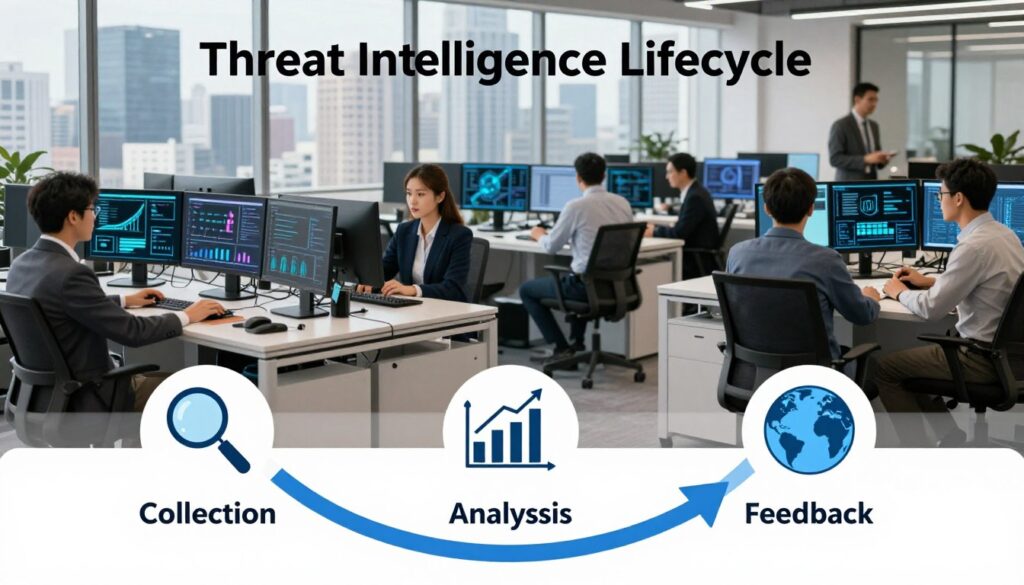
Begin with clear, business-centered questions that guide every step of the lifecycle.
Requirements
Start by translating business risk into specific questions. For example: which ransomware crews target healthcare in Italy and which techniques bypass email controls?
Collection
Collect a balanced mix of external feeds (commercial and open), ISACs, MISP communities, and dark‑web monitoring.
Combine those with internal telemetry—EDR, firewall, email, and cloud logs—to ground signals in your environment.
Processing
Normalize formats, de-duplicate indicators, and filter low-confidence entries. Enrich data with MITRE ATT&CK mappings and asset tags.
Use AI/ML to assist correlation and trend detection, but keep analysts in the loop to validate results.
Analysis
Turn patterns into testable hypotheses—e.g., this actor’s initial access technique appears in our email logs. Then map findings to controls and detections.
Dissemination
Tailor outputs for each audience: machine-readable IoCs for SIEM, playbook updates for IR, and concise risk summaries for executives.
Feedback
Run post-action reviews to verify which detections fired, which were noisy, and which controls reduced exposure. Update your requirements and repeat the cycle.
“A closed feedback loop is the fastest path from raw data to measurable security outcomes.”
| Lifecycle Stage | Primary Owner | Key Output | Example Tool/Source |
|---|---|---|---|
| Requirements | Risk Owner / SOC Lead | Scoped questions & success criteria | Executive briefings, risk register |
| Collection | Collections Analyst | Aggregated feeds & telemetry | MISP, ISACs, EDR logs |
| Processing | Data Engineer | Normalized, enriched indicators | TIP, STIX/TAXII, ML pipelines |
| Analysis & Dissemination | Senior Analyst | Detections, playbooks, exec summaries | SIEM rules, SOAR, reports |
| Feedback | Team Lead | Updated requirements and metrics | Post-action reviews, dashboards |
How to build a threat intelligence program

Begin with a simple charter: what risks matter, who decides, and how fast you must act.
Define scope, stakeholders, and decision timelines
Clarify which assets, business processes, and compliance duties are in scope. Set decision windows so insight arrives before leadership must act.
Map stakeholders across SOC, CSIRT, vulnerability management, compliance, and executives. Capture each group’s preferred format and cadence.
Set requirements and success criteria
Turn stakeholder questions into measurable goals. For example: reduce time to detect credential-stuffing or cut phishing false positives by a set percent.
Prioritize by industry, geography, and attack surface
Build a collection plan focused on actor targeting, exploited vectors, and sector-specific feeds such as ISACs. Prioritize internet-facing apps, email, VPNs, and cloud identities first.
- Translate: map findings to actions—SIEM rules, firewall blocks, or playbook updates.
- Right-size: match workflows and tools to team capacity to avoid bottlenecks.
- Govern: define roles, handoffs, and a 90-day plan with milestones for feed hygiene, ATT&CK gap mapping, and executive readouts.
Core tools and threat intelligence platforms you can operationalize today

Select tools that turn diverse data streams into clear, actionable alerts for daily operations.
Your next TIP should simplify ingestion, normalization, scoring, and sharing so analysts spend time on response—not parsing formats.
What a modern platform must deliver
Look for a system that ingests many feeds, normalizes formats, de-duplicates indicators, and scores by confidence and relevance.
APIs and STIX/TAXII support matter. They speed integration with SIEM, EDR, firewall, and SOAR for automated actions.
Platform examples and integrated approaches
Recorded Future offers broad coverage and real-time scoring. Mandiant provides deep attribution and sector assessments. IBM X‑Force links research to QRadar for action.
Anomali ThreatStream and Cortex XSOAR focus on aggregation and orchestration. Stellar Cyber’s Open XDR enriches events at ingestion and automates containment across endpoint and cloud.
“A modern platform must turn data into reliable signals your security teams can act on.”
Choose deployment (SaaS vs on‑prem) and vendors that scale with your data volumes and compliance needs.
Operationalizing intelligence across SOC and incident response
Turn raw feeds into reliable signals that your SOC and response teams can act on within minutes.
Feed-to-detection: SIEM correlation, alert enrichment, and tuning
Implement a feed-to-detection pipeline so curated indicators are normalized, scored, and fed into your SIEM.
Use automated expiry for low-confidence items to cut noise. Enrich alerts with actor context, techniques, and asset tags so analysts triage faster.
From IoCs to TTPs: mapping detections to MITRE ATT&CK
Map rules and hunts to ATT&CK techniques to catch behavior, not just static indicators. This improves resilience when infrastructure changes.
Link detections to playbooks and control owners so each alert points to a clear response path and measurable outcome.
Automation with SOAR/XDR: playbooks, containment, and response
Deploy SOAR and XDR playbooks to automate containment—isolating endpoints, blocking IPs, disabling accounts, and adding MFA prompts when confidence thresholds are met.
Integrate intelligence tools with ticketing and case management so incidents retain full context and clean handoffs to incident response.
- Tune detections continuously using feedback on false positives and missed events.
- Align escalation matrices with risk scoring so high-impact alerts page on-call responders immediately.
- Validate playbooks with purple-team exercises and known actor emulations.
“Automation plus context shortens time to containment without losing analyst oversight.”
Threat data sources and intelligence feeds that actually add value
Choosing the right mix of feeds and logs makes the difference between noise and timely, actionable alerts.
For an effective threat intelligence program, focus on quality, not volume. Evaluate commercial and open-source feeds by scope, freshness, and confidence. Pick feeds that cover your industry and geography to avoid paying for duplicates.
Information-sharing communities such as ISACs and MISP give sector-specific sightings and context. They often provide curated indicators that align to regional risks and regulatory needs in Italy.
Internal telemetry: ground truth
Prioritize EDR alerts, firewall denies, email threat samples, and cloud audit logs. These logs validate external signals and reveal local attacker behavior.
Surface, deep, and dark web monitoring
Add monitoring to detect leaked credentials, brand misuse, and targeted chatter. Tools for digital risk protection help you act early—reset accounts or request takedowns.
- Centralize collection in a SIEM or TIP to automate parsing, enrichment, and lineage.
- Set quality gates for indicators: confidence, age, and source reputation before ingestion.
- Track source performance by hits, false positives, and operational impact to refine subscriptions and cut cost.
“Blend commercial feeds with community sharing and internal logs to turn external warnings into verified detections.”
Governance, roles, and collaboration for security teams
Clear role definitions and simple handoffs make your insights useful under pressure.
Who needs what:
Analysts and SOC
Equip analysts with machine-readable IoCs, YARA/Sigma rules, and repeatable workflows. This speeds detection and lowers noise.
Give your SOC curated watchlists, ATT&CK maps, and severity scoring so triage focuses on real risk.
CSIRT and investigations
Provide CSIRT with actor profiles, campaign timelines, and infrastructure maps. These assets shorten containment and cleanup time.
Executives and governance
Deliver concise strategic briefs that quantify exposure, expected loss reduction, and investment trade-offs. That ties technical findings to business decisions.
“Formal SLAs, ownership, and review cadences turn ad-hoc alerts into predictable outcomes.”
- Define deliverables per role and standardize formats.
- Institutionalize a feedback loop so each team reports what worked and why.
- Use shared platforms, playbooks, and documented handoffs to avoid bottlenecks.
| Role | Primary Deliverable | Tooling | Success Metric |
|---|---|---|---|
| Analysts | Machine-readable IoCs; YARA/Sigma | TIP, EDR, SIEM | Detection accuracy, rule hit rate |
| SOC | Enriched incidents; watchlists | SIEM, SOAR | Mean time to triage |
| CSIRT | Investigation packages; actor maps | Case mgmt, forensic tools | Containment time, case completeness |
| Executives | Strategic briefs; risk metrics | Dashboards, exec reports | Decision latency, investment ROI |
Measuring effectiveness: metrics, maturity, and continuous improvement
Measure what changes: use clear KPIs so you can show earlier detection and faster recovery.
Good metrics link daily work to business risk. Track outcomes that prove your approach shortens time to detect and resolve incidents.
Key outcomes to track
- MTTD and MTTR: measure these across priority use cases to show that detection and response are improving.
- Precision and recall: monitor false positives, missed detections from retrospectives, and alerts resolved without escalation.
- Blocked impact: count prevented credential misuse, quarantined malware, and takedowns tied to reduced financial risk.
- Feed and source efficacy: score feeds by hit rate, confidence alignment, and operational value; prune underperformers.
Program maturity and continuous checks
Instrument the lifecycle with checkpoints to confirm your requirements were met and dissemination hit SLAs.
Advance maturity from indicator-driven work to behavior-led coverage mapped to MITRE ATT&CK. Use hunts and analytics to close technique gaps and raise detection quality.
| Metric | Owner | Target |
|---|---|---|
| MTTD / MTTR | SOC Lead | Reduce by 25% in 90 days |
| False positives / hit rate | Analysts | Improve precision by 30% |
| Blocked impact | CSIRT | Quantify prevented losses |
“Use quarterly reviews to refresh requirements, re-rank threats, and update KPIs so gains remain aligned with business priorities.”
Also track analyst workload—cases per analyst, triage time, and automation coverage—to optimize staffing and platforms. Run quarterly program reviews to keep goals current with evolving risk in Italy and beyond.
Conclusion
Close the loop so your teams turn feeds and analysis into faster, repeatable incident response.
You will leave with a clear approach: define requirements, prioritize actors and techniques, pick platforms and tools that fit use cases, and operationalize through SOC and incident response.
Choose intelligence platforms and security platforms that integrate via STIX/TAXII and APIs. Run short pilots to validate value—Open XDR, Recorded Future, Mandiant, or Cortex XSOAR each offer different strengths.
Standardize quality gates for threat data, consolidate feeds, map ATT&CK gaps, deploy enriched detections, and automate containment for high-confidence matches.
In 90 days, consolidate feeds, tune detections, measure MTTD/MTTR improvements, and meet monthly so analysts and management refine indicators and requirements. That feedback loop makes the lifecycle compound real value for your organization.
FAQ
What is the most practical first step to build a cyber threat intelligence program?
Start by defining clear requirements that tie to business risk. Identify the decisions you want to improve, the teams that will act on insights, and the timelines for those actions. This helps you choose data sources, tools, and metrics that align with your priorities.
How does turning raw data into actionable information change your defense?
When you normalize and enrich signals, your SOC can detect patterns faster and reduce false alerts. Enriched context—such as adversary techniques, campaign links, and confidence scores—lets you prioritize investigations and deploy targeted defenses instead of chasing every indicator.
What are the common costs of getting this process wrong?
Poor alignment and low-quality feeds increase detection time and false positives, which drains analyst time and raises incident impact. Organizations risk longer dwell time, higher remediation costs, and reputational damage from breaches that could have been mitigated with better visibility.
How should you set collection priorities across external feeds and internal telemetry?
Prioritize sources that directly address your intelligence requirements. Combine high-fidelity internal telemetry—EDR, firewall logs, cloud and email signals—with curated commercial feeds and vetted open-source data. Balance freshness and confidence to avoid noise.
What processing steps are essential before analysts begin work?
Normalize formats, de-duplicate entries, and enrich items with context such as MITRE ATT&CK mappings and confidence scoring. Use STIX/TAXII and APIs to streamline ingestion, and apply automated enrichment to speed analyst triage.
How do you turn patterns into actionable analyst hypotheses?
Analysts should link indicators to observable behaviors, map those behaviors to techniques, and assess intent and impact. Form hypotheses about likely adversary goals and next steps, then test them against telemetry and threat feeds to refine detection logic.
What formats and standards should you require from vendors?
Insist on STIX/TAXII support, robust APIs, and common export formats. These standards allow you to automate sharing, integrate with SIEM and SOAR systems, and maintain consistent scoring across multiple platforms.
Which platform capabilities matter most for operational use?
Focus on ingestion scale, normalization, scoring, enrichment, and sharing. Look for automation-ready APIs, integration with SIEM/SOAR/EDR, and role-based outputs tailored for SOC analysts, incident responders, and executives.
Can you name established vendors to evaluate for platform and feed coverage?
Consider platforms such as Recorded Future, Mandiant, IBM X-Force, and Anomali for commercial feeds and context. Evaluate how each integrates with your SIEM, EDR, and SOAR tools before committing.
How do you operationalize outputs for SOC and incident response teams?
Deliver prioritized alerts, enriched IoCs, and behavioral detections. Integrate playbooks into SOAR for containment steps and automate routine responses. Ensure analysts get concise, action-oriented summaries and recommended containment actions.
What role does MITRE ATT&CK play in detection and response?
Mapping detections to ATT&CK helps you understand adversary methods, build behavior-based rules, and communicate gaps to stakeholders. Use the framework to prioritize detections that indicate higher-risk techniques.
Which external feeds add real value versus creating noise?
High-quality commercial feeds with clear provenance and confidence ratings add value, as do vetted ISAC contributions and curated open-source datasets. Avoid broad, low-confidence feeds that generate volume without context.
How should you combine community sharing and commercial data?
Use community feeds (ISACs, MISP) for sector-specific context and quick warnings, and commercial sources for enriched analysis and attribution. Cross-validate items across sources to increase confidence before actioning.
What internal signals are most useful for correlating with external indicators?
Prioritize EDR telemetry, firewall and proxy logs, cloud access logs, and email gateway data. These sources provide high-fidelity matches to externally observed indicators and reveal attacker activity within your environment.
How should governance and roles be structured for effective operations?
Define clear ownership across analysts, SOC, CSIRT, and executive stakeholders. Assign decision rights for triage, containment, and disclosure. Establish SLAs for detection and response tied to business risk.
What metrics best show program effectiveness?
Track mean time to detect (MTTD), mean time to respond (MTTR), false positive rates, and prevented impact. Also measure indicator-to-detection conversion and the proportion of alerts enriched with contextual scoring.
How do you evolve from indicator-driven to behavior-led practices?
Shift focus from chasing IoCs to modeling adversary behaviors and techniques. Build detections that look for patterns and anomalies, and use playbooks that respond to tactics and procedures rather than single indicators.
How often should you review and update intelligence outputs and feeds?
Review feeds and detection logic continuously, with formal quarterly evaluations. Use feedback from incident post-mortems and SOC metrics to retire noisy sources and tune enrichment and scoring rules.