
Surprising fact: sites that organize pages around a central pillar and linked child pages can lift traffic across an entire site by double digits within months.
You will move from scattered articles to a connected system that signals depth to both readers and search engines.
This approach centers a pillar page that links to related topic pages, and each child page links back to the pillar.
That interlinking improves navigation and expands long‑tail visibility, which matters for modern, conversational search queries favored by Google.
See real examples like WPBeginner, DICK’S Sporting Goods, and Wolters Kluwer, where hubs grew rankings and traffic at scale.
In this guide for websites in Italy, you’ll get practical models, research workflows, and interlinking patterns so you can build and maintain a hub that compounds value.
Key Takeaways
- One pillar page can boost the performance of related pages through smart internal links.
- Topic-based planning improves user experience and long-tail search coverage.
- Follow proven hub and hybrid models used by major brands to scale traffic.
- Align pages to user intent so readers find the right information at the right time.
- Measure cluster-level KPIs—rankings, traffic, engagement—to iterate fast.
Why Topic-Based SEO Matters Right Now
Ranking today depends on how well your pages show relationships, synonyms, and subtopics. Google’s recent updates reward that breadth, especially for longer, conversational queries and voice search.
When you group related pages, search engines map meaning more easily. That improves visibility for both broad queries and specific, long-tail questions.
- Broader coverage in results — you rank for discovery and for exact answers.
- Better user experience — visitors move through related pages and stay longer.
- Stronger authority — linked subtopics signal expertise to engines.
“Organizing pages by theme makes a website easier to understand and more useful to people.”
Track cluster-level visibility, organic clicks, and engagement to measure performance. Over time this approach compounds gains and keeps your site aligned with how search works today in Italy and beyond.
Clarifying the Models: Topic Clusters, Pillar Pages, and Hubs
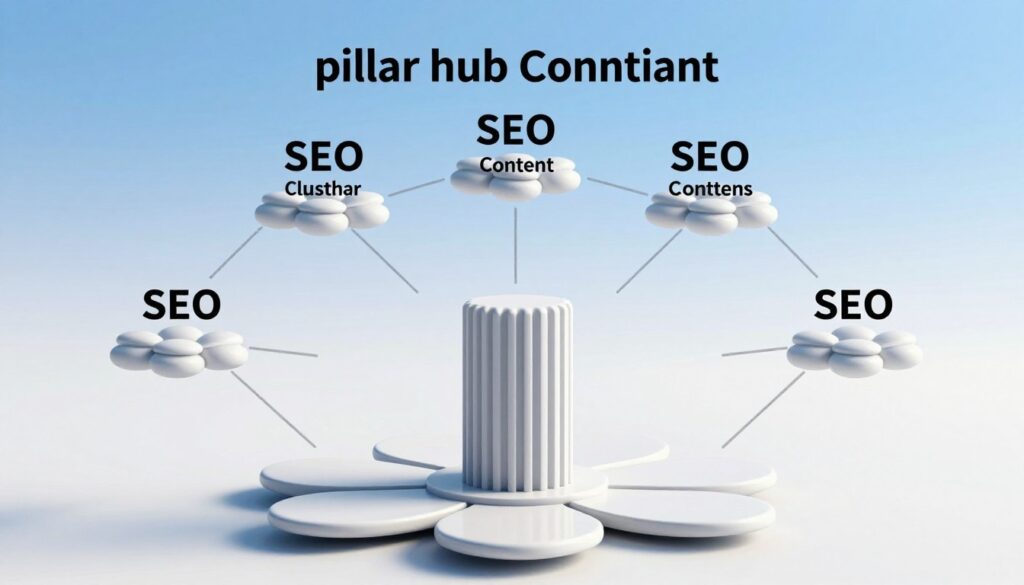
Knowing when to use a navigational hub versus an in-depth pillar helps you shape site architecture.
What a topic cluster is and how it interlinks
A topic cluster groups related pages around a central hub or pillar. Each supporting page links back to the hub, and the hub links out to each page.
This pattern helps search engines connect related topic pages. When one page ranks, nearby pages often improve too.
Pillar page vs. hub page: core function and objectives
Pillar pages deliver exhaustive information on a single subject and aim to earn backlinks.
Hub pages act as navigational directories, routing visitors to more specific pages for fast discovery.
Hybrid hub/pillar approaches and when to use them
Use a hybrid when you need depth plus clear navigation—for example, a long pillar with a directory section that links to subpages.
This blend suits large topics that must both rank and guide users across many pages.
| Model | Main Goal | When to Use |
|---|---|---|
| Pillar page | Depth and backlinks | Single-topic authority, detailed guides |
| Hub page | Discoverability and navigation | Broad topics with many subpages |
| Hybrid | Depth + directory | Large, complex topics needing UX and ranking |
Aligning Search Intent and Keyword Research for Clusters
Map search intent first so each page answers the right question at the right funnel stage. This helps you assign head terms to pillar pages and long-tail keyword hits to specific resources.
Top-of-funnel queries are broad and discovery-focused. Use Semrush or Ahrefs to find high-volume topics that define your hub pages.
Mid-funnel queries show consideration—compare options, features, or how-tos. LowFruits is useful here because it highlights low-difficulty long tails and supports SERP clustering by intent overlap.
Bottom-of-funnel queries are transactional and specific. Target these with focused blog posts or product pages that match exact user questions.
- Use SERP and semantic clustering to group queries by intent and language.
- Prioritize keywords by volume and difficulty for quick wins.
- Plan each page around a single primary keyword and a small set of related secondaries.
Document your keyword research in a tracker so your team sees which topics, keywords, and pages are in flight. Structure titles and H2s to reflect intent and improve click-through and user experience on your site for Italian audiences.
Choosing Core Topics That Build Authority

Start by choosing a few broad topics that align with your products and the searches your Italian audience actually performs.
Prioritization hinges on three practical criteria: relevance, depth potential, and demand.
Prioritization criteria: relevance, depth potential, and demand
Relevance: shortlist 3–5 topics where your expertise and offerings intersect with clear user intent and search volume.
Depth potential: score each topic by how many credible pages you can create. Pick topics that support evergreen pages, guides, and tool-focused pieces.
Demand validation: use research tools and trend lines to forecast which topic will sustain traffic and keyword growth.
“Choose topics that let you publish many useful pages — that is how a site grows authority over time.”
Plan an editorial slate that sequences early wins (lower difficulty) first. Define success per topic: rankings, traffic, and conversions. Ensure your website taxonomy can host a hub or pillar for each selected topic so the site scales without friction.
| Topic | Depth Potential | Demand (trend) | Authority Signals |
|---|---|---|---|
| WordPress SEO (example) | High — guides, plugins, tutorials | Stable growth | Backlinks from publishers |
| Security & Maintenance | Medium — how-tos, audits, checklists | Rising | Mentions in technical forums |
| Performance & Speed | High — tests, optimizations, case studies | Consistent demand | Case study citations |
Building the Pillar: Comprehensive Coverage That Earns Links
When a pillar thoroughly maps a topic, it earns trust from readers and visibility in search results. A pillar page should be exhaustive but easy to scan. Start with a linked table of contents that lets visitors jump to the section they need.
Information architecture and section planning for pillars
Blueprint the page so it covers every major subtopic and anticipated user question. Include short sections for beginners and deeper sections for experts.
Use a hybrid approach when a directory of FAQs or related pages improves navigation and discovery.
On-page optimization for breadth, depth, and UX
Optimize headings, media, and meta elements to aid readability and mobile experience. Add natural internal links to supporting pages and authoritative external citations.
- Include a hyperlinked TOC and anchor-ready headings.
- Balance breadth with actionable depth so the page earns links on merit.
- Use schema where relevant and ensure fast load times.
“A well-structured pillar becomes the reference other sites cite.”
Track link acquisition and engagement. Use those signals to refresh sections that underperform and keep the page current for Italian search and readers.
Creating Cluster Content That Satisfies Specific Questions
Map each specific user query to a single page so your site serves precise search intent. Focus on narrow long-tail keywords and build one clear answer per page.
Turn research into tightly scoped pages. Write practical steps that solve the query. Use lists, examples, and a visual to speed understanding.
Turning long-tail research into high-value subtopics
Pick one primary keyword per page and include two close variants. Keep titles and headings aligned to that phrase.
Link back to the pillar and to adjacent pages. Aim for roughly 80% of your internal links to stay within the same cluster to show topical cohesion.
Avoiding cannibalization with clear targeting
Give each blog post a unique intent and measurable goal. Use descriptive anchor text for links so the destination is obvious to users and search engines.
“One focused page beats several vague pages for the same query.”
- Publish one page at a time and iterate using performance data.
- Keep quality consistent to protect trust and conversions.
Internal Links and Site Architecture That Signals Expertise
Good linking turns isolated pages into a clear map that both visitors and search engines can follow.
Start by enforcing hub-to-spoke and spoke-to-hub patterns across every page in a topic group. Each hub page should link to its spokes, and each spoke should link back. This makes critical pages easy to reach in three clicks or fewer.
Hub-to-spoke, spoke-to-hub, and spoke-to-spoke patterns
Use spoke-to-spoke links where topics overlap. Lateral links create pathways that help users explore deeper guides and related pages.
Anchor text for semantic relevance
Standardize anchors so they match the destination topic. Prefer descriptive phrases over exact-match stuffing. This helps engines interpret the thematic relationship between pages.
Recommended link density within clusters
Keep most links inside the same cluster to concentrate authority. Aim for roughly 60–80% of a page’s links to point to related topic pages.
| Goal | Pattern | Recommended ratio |
|---|---|---|
| Discoverability | Hub → Spoke | 3–5 prominent links from hub to pages |
| Authority flow | Spoke → Hub | 2–4 contextual links back to hub |
| Depth & UX | Spoke ↔ Spoke | 1–3 lateral links where topics overlap |
“Use a link assistant or a crawl to find orphaned pages and missing connections.”
Tools like AIOSEO Link Assistant can highlight gaps and speed fixes. Verify that high-value pages get links from authoritative hubs to help indexing and ranking in Italy and beyond.
content cluster strategy: From Planning to Ongoing Expansion

Turn keyword research into scheduled work waves so you grow topics without chaos. Use tools like Asana or a shared spreadsheet to track every step from brief to publish.
Set roles, tags, and deadlines. Tag each page to its cluster so the team knows which hub it belongs to. Log outlines, sources, and designs in one central place for faster reviews.
Editorial workflows and tracking progress
- Create an editorial board that approves briefs and assigns owners.
- Move items through defined steps: research → draft → review → design → QA → publish.
- Batch similar pages into waves to ship faster and keep quality high.
Maintenance cadence to prevent content decay
Schedule time-bound updates. Aim to revisit each pillar and its linked pages within six months.
| Task | Frequency | Owner |
|---|---|---|
| Performance review | Monthly | SEO lead |
| Update or prune pages | Every 6 months | Editorial board |
| Internal link backfill | Ongoing | Content engineer |
“A repeatable playbook keeps your website growing without losing cohesion.”
Measuring Performance and Iterating for Growth
Measure how each topic group moves the needle on organic goals and make fixes that compound over time.
Define cluster-level KPIs so you see the whole picture: rankings for targeted keywords, organic traffic to the pillar and linked pages, engagement metrics, and conversions tied to business outcomes.
Cluster-level KPIs: rankings, traffic, engagement, conversions
Track keyword visibility with Semrush or Ahrefs. Watch which keywords climb and which fall in the search results.
Monitor traffic trends in Google Analytics. Compare pillar page traffic to supporting pages and note where users drop off.
Evaluate engagement—time on page, bounce rate, and pages per session—to infer user intent and UX gaps.
Diagnosing gaps and prioritizing updates
Audit search results to spot missing subtopics and SERP features your audience expects. Check backlinks to the pillar to measure authority lift.
Find cannibalization by mapping keywords to pages. Consolidate or redirect where intent overlaps and hurts rankings.
Prioritize fixes by likely impact: focus first on pages near page-one or terms with high conversion value. Report results clearly to stakeholders, linking gains to revenue, leads, or other KPIs.
| Measure | Tool | Action |
|---|---|---|
| Keyword visibility | Semrush / Ahrefs | Track ranking shifts; expand keywords where pages perform well |
| Organic traffic | Google Analytics | Compare pillar vs. supporting pages; flag drops |
| Engagement | GA + heatmaps | Improve UX on pages with low time or high bounce |
| Authority signals | Ahrefs | Target link outreach for pillar page to boost cluster results |
Set a monthly iteration cycle. Convert insights into small updates fast. Over time, these steps compound and lift search performance across your site in Italy.
Real-World Blueprints, Tools, and Workflows
Practical examples and repeatable workflows help you scale a hub-and-pillar approach across many pages without losing quality.
Examples that scale: sports and professional services
Study DICK’S Pro Tips to see a single hub powering hundreds of sport-specific pages. That hub improves discoverability and lifts organic traffic across many long-tail queries.
Wolters Kluwer’s Tax Resource Center shows how a professional services pillar can boost top-10 results by large margins. Both examples demonstrate how a well-structured hub and pillar mix builds authority in niche verticals for Italian audiences.
Keyword discovery and clustering tools
Use Conductor Explorer, Semrush, Ahrefs, and LowFruits to map opportunity and difficulty quickly.
LowFruits’ clustering and SERP analysis work well for grouping queries and avoiding duplicate pages. Combine tool output with manual SERP checks so your pages match intent and rank where search engines expect them to.
Set a monthly dashboard that shows visibility, traffic, and pipeline impact. Keep reports simple: rank changes, pillar traffic, and conversions tied to business goals.
“Show clear, repeatable gains and stakeholders will fund continued expansion.”
| Blueprint | Primary benefit | Tools & workflow |
|---|---|---|
| DICK’S Pro Tips | Scales discoverability across sports | Hub + many sport pages; Semrush, manual SERP audits |
| Wolters Kluwer Tax Center | Authority for professional queries | Pillar-first build; Ahrefs for backlinks, LowFruits for grouping |
| Team dashboard | Faster decisions and funding | Standardized dashboard (visibility, traffic, pipeline) |
Quick operational tips
- Refine templates for hub, pillar, and pages so teams reuse proven layouts.
- Document sources and lessons learned in a single dashboard for fast action.
- Use a monthly cadence to convert findings into small updates that compound.
Conclusion
Start small: pick one core topic and publish a linked page this month. Plan the supporting pages so each post answers a single intent and links back with descriptive anchors.
Focus on building connected clusters that improve user experience and make it easy for search to find related topic pages. Track a handful of keywords at the cluster level and measure early results.
Commit to a maintenance rhythm—review every six months—and use real examples and reliable tools as your source for decisions. This way you protect gains, show business benefits, and iterate toward sustained growth across your blog and resource center.
FAQ
What is a topic-based SEO approach and why does it matter for your site?
A topic-based SEO approach groups related pages around a central hub or pillar to show search engines your authority on a subject. This improves ranking potential, boosts organic traffic, and gives readers a clearer path through your site. It helps you target broad keywords and many long-tail queries without scattering effort across unrelated pages.
How do pillar pages differ from hub pages, and when should you use each?
A pillar page provides comprehensive coverage of a core subject and links to more specific subpages. A hub page organizes related resources and may be less exhaustive. Use a pillar when you need a definitive guide that earns links and ranks for broad queries. Use a hub when you want a navigational center that groups deep articles for user experience and internal linking.
How should you map search intent across top, middle, and bottom of funnel pages?
Map top-of-funnel pages to broad informational queries, middle-of-funnel to comparison and how-to topics, and bottom-of-funnel to product, conversion, or transactional pages. Align headings, calls-to-action, and internal links so each page serves the user’s intent and moves them along the path to conversion.
What criteria help you choose core topics that build authority?
Prioritize topics by relevance to your audience, search demand, and potential for deep coverage. Pick subjects where you can create unique, high-quality material that attracts links and repeat visitors. Also consider competitive density and the time needed to rank and maintain those pages.
How do you structure a pillar page for both users and search engines?
Break the page into clear sections with an overview, key subtopics, and links to detailed subpages. Use descriptive headings, good UX, fast load times, and mobile-friendly layouts. Include internal links to related posts and resources to distribute authority and help readers find in-depth answers.
How can you turn long-tail keyword research into valuable subtopic pages?
Group related long-tail queries by intent and create focused posts that answer each specific question. Use clear titles, targeted headings, and concise answers that match search snippets. Link each subpage back to the pillar to consolidate authority and avoid overlapping coverage.
What steps help you avoid keyword cannibalization within your site?
Perform an audit to find overlapping pages, consolidate similar posts, and assign unique target keywords to each page. Use canonical tags when needed and create clear hub-to-spoke linking so search engines understand which page should rank for broader queries.
What internal linking patterns best signal expertise to search engines?
Use hub-to-spoke links from the central page to detailed posts, spoke-to-hub links back to the pillar, and selective spoke-to-spoke links for related subtopics. Keep links natural, use descriptive anchor text, and maintain a balanced link density so authority flows predictably across the site.
How many internal links should you include within a group of related pages?
There’s no fixed number, but keep links purposeful and user-focused. Aim for enough links to connect the pillar and its spokes clearly without overwhelming the page. Monitor engagement and crawl behavior, and adjust link volume so pages load fast and remain readable.
How do you run an editorial workflow for ongoing topic expansion?
Define roles for research, writing, editing, and publishing. Use a content calendar that maps pillar updates and new subtopics. Track progress with simple KPIs like publishes per month, organic visits, and backlinks. Schedule regular reviews to prioritize updates and new opportunities.
What maintenance cadence prevents pages from losing organic visibility?
Review pillar and spoke pages at least quarterly for accuracy, linking health, and freshness. Update statistics, add new subtopics, and fix broken links. A proactive maintenance plan reduces decay and keeps your site relevant to both users and search engines.
Which KPIs indicate a successful topic hub at the cluster level?
Track organic rankings for core and long-tail keywords, aggregated organic traffic, engagement metrics like time on page and bounce rate, and conversion outcomes tied to the hub. Monitor backlink growth and the number of internal links pointing to the pillar to measure authority gains.
How do you diagnose gaps and decide which pages to update first?
Identify pages with declining traffic, falling rankings, or poor engagement. Compare search intent against page content and check competing pages for topical depth. Prioritize updates based on impact potential: high-traffic pages, near-miss rankings, and conversion drivers come first.
What tools help with keyword discovery, grouping, and reporting for hubs?
Use tools like Ahrefs, SEMrush, Google Search Console, and Brandwatch for keyword discovery and performance tracking. Use spreadsheet or project tools to group keywords, assign pages, and report progress to stakeholders. These tools help you scale research and prove ROI.
Can you give real-world examples of hubs that scale across niches?
In sports, a hub on “basketball training drills” can link to player-position guides, drills by age, and injury prevention posts. In professional services, a tax advisory hub can cover planning, compliance, and industry-specific advice. Both formats use a thorough pillar plus many targeted subpages to capture demand.
How should you structure anchor text to improve semantic relevance?
Use natural, descriptive phrases that match the target topic and vary anchor text to avoid over-optimization. Prefer user-friendly anchors—like “how to optimize on-page SEO”—that describe the destination page, and reserve exact-match anchors sparingly.